

 |
Unfortunately, there are also cases of fraud (mislabelling) or even honey without label (honey from street vendors).
The most common method of honey adulteration is the addition of sugar or glucose syrup. However, this can be
uncovered using one of these simple methods.
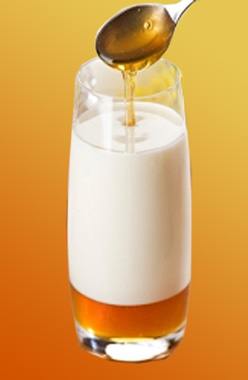
Good honey dissolves poorly in water, so as you know it from syrup. If you put some honey in a glass of cold water or
milk the honey stays together. It "sits" on the bottom of the glass. If the honey immediately dissolves easily, it is
- unfortunately - not pure honey.
Second method: if honey is flowing from a spoon onto a plate this will be continuously and compact. If we observe
instead of this individual drops that are forming and falling down, this is syrup.
Another experiment can help us to identify the presence of water in honey. Place a drop of honey on blotting paper.
When these drops is taken, the honey is not pure.
Honey has a low water activity which inhibits the growth of microorganisms. So it should not absorb any moisture from
the environment in tightly closed containers and stored away from sunlight.
Food safety is a very important issue nowadays. When you buy pure honey from a beekeeper, you do not need to make any
experiments. The beekeeper, or the company can not risk contaminating the product. He can not sell bad products. He wants
to win the customer wants and to meets his satisfaction!
 Keep your eyes open to the label!
Sources (all pages »honey, honey!«):
wikipedia |
How Honey is Made |
Meli Malisiova
apiculture | agriculture
