

 |
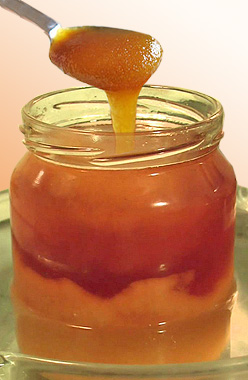
Honey can be liquid or solid (crystallized). This depends mainly on the relation of fructose-glucose, but also on how the honey is
processed and stored. The consistency ranges from runny via creamy to solid. It is just like the color and flavor depending
visited the flowers or the collected honeydew. Common colors are white to light yellow, yellow, beige, brown and green black.
Honey is a thick liquid to solid, partially crystallized substance mainly composed of the sugars fructose (27 to 44%) and glucose
(dextrose, 22 to 41%) and water (15 to 21%, heather honey consists to 23%). The fructose predominates mostly against the glucose:
On average, about 38% fructose and 30% glucose are included. For some types of honey but the composition differs sharply,
for example, is in rape honey, the ratio of fructose to glucose about 60 : 40.
Due to its high sugar and low water content honey is durable, but it can crystallize and thus be determined. Tight honey often is
colloquially referred as candied honey, however, the term candying describes the coating of food with a sugar solution for the
purpose of sweetening and preservation.
For the tendency to crystallize the ratio of fruit to sugar (the two main components) is responsible. If this is about 1: 1, the
crystallization is carried out within a few days. In the honeydew honeys, such as the pine honey, the ratio is about 1.6: 1. This
honey remains for months or even years in liquid form.
If your honey crystallizes, do not worry! Be glad to see that you have purchased an exquisite honey. (Adulterated honeys crystallize
barely). You can restore the original state by setting your honey in a pot of boiling water and in a short time the honey is liquid
again. Alternatively, you can place it on a radiator, which of course requires more time.
Meli Malisiova
apiculture | agriculture
