

 |
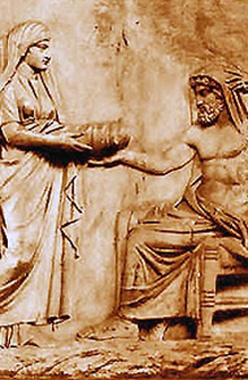
Aristaeus had a pretty eventful life and where he settled at times, he left all the information about the olive tree. He worked even as a
healer. When he heard the news of the death of his son Actaeon, he went to the island Ceon (Ceam, Keos), where he fought against the
plague. Later he landed in Sardinia, Sicily and other Islands, where he brought the human culture, therefore it is also called bearer
of culture.
Later Aristaios went to Thrace, where he met the singer Orpheus. In addition to all his good deeds is also told that Aristaeus had tried
Eurydice doing violence. Therefore, the beloved wife of Orpheus died.
The nymphs were very angry about it. They left all the bees die and all the animals of Aristaeus.
Now he turned to his mother Cyrene, who told him that he could reconcile the nymphs through sacrifice of four bulls and four heifers at
the Tomb of Eurydice. The nymphs would bring him back new bees.
Aristaios and Bugonie
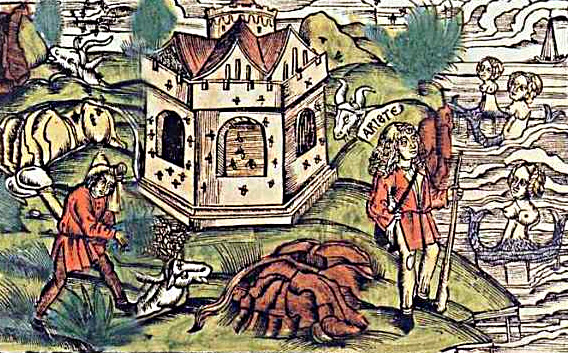
In ancient times and in the Middle Ages there was a fabulous idea, called the Bugonie. The people thought that a bee colony and other insects
would arise spontaneously from the decaying body of a dead bull.The Bugonie that may came from Persia, found its way into the ancient world via Egypt.
The
doctrinewas probably practice, although modern biology and the representa-
tives of the beekeeping deem it impossible.
Concerning the end of Aristaios it is handed down, he was eventually disap-
peared without cause. He is said to have thrown hemself into a cave so that
people should believe that he was caught up into the divinity.
Bibliography:
Virgil, Vougonia
The Epyllion of Aristaeus (Agricultural VI 281-558)
Meli Malisiova
apiculture | agriculture
