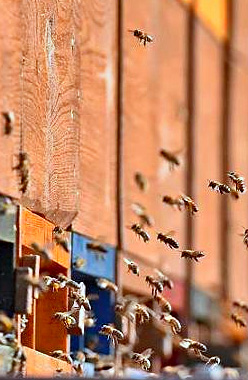
the beehive 4 
The bees have a year cycle, which depends on climatic conditions. In principle, this year cycle is always the same.
However, it can move up to a few weeks depending on the development of the weather and colony. In contrast to the
agriculture, where the annual cycle begins in the spring, beekeepers start the financial statements with the summer
period. It happens actually at the time, when the bees swarm, and a young colony arises.
In August and September: a winter preparation comes. Brood care ceases, and the bees become long-living. A fat and
protein upholstery is put in the paunch and glands. The drones are driven away from the population.
In October to February: there is a spherical bee cluster over several lanes of honeycomb in the hive. The bees consume
the stored honey. The core temperature of the bee cluster is around 25 ° C. In winter the new breed is created with help of
the body's own reserves. The temperature reaches 35 ° C. When the outdoor temperature rises above 10 ° C, the first cleaning
and water flights of the bees are starting. As soon as pollen is available, the breeding starts.
In March and April: the long-living winter bees are replaced by young summer bees. The high performance of brood care
starts, which brings the slight short term weakening in the colony power. Afterwards the bee colony gain strength again. As
soon as the first flows are there, the stocks are created. The drone breeding begins.
In late spring and in summer: the peak of development is reached. Nurse bees become unemployed due to the growing size
of the colony. The colony is constructing Queen cells. When the time has come, the population splits up via raving.
Honey bees are fascinating insects. The more you are dealing with them, the more interesting they seem to you. Though the honey
bees are able to defend themselves and possess a poison sting, they sting only if they feel directly threatened or attacked.
For example, bees that collect nectar and pollen in the garden or in park are not aggressive, but rather totally involved in
their task.
Take advantage of such a possibility to look at these wonderful animals precisely!
source:
wikipedia.org/wiki/life cycle
« ...back