

 |
Originally, the bees lived wild in naturally occurring tree hollows in the woods. In the early days the man began to offer the bees
hollowed-out tree trunks or other cavities as nesting site. Disadvantage of all these dwellings was that honey can be harvested only
in the way, that a part of the honeycomb work of bees is cut out and so destroyed. It was made of wood, and could be arranged by the
beekeeper from behind. The dwelling is called booty. Modern, so-called »magazine booties«, consist of a box made of wood or plastic.
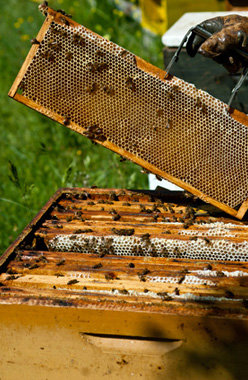
Its movable honeycomb construction represents a significant step forward in the beekeeping. In this process the honeycombs are deployed
in frames into the booty. The honeycomb filled with honey can be removed and replaced with blank one. In this way the bees can spend
less energy for the construction of honeycombs.
In beekeeping, a movable wooden frame from a booty, in which the bees have built the real honeycomb, is meant under a honeycomb
(honey, pollen, or brood comb).
A »honeycomb« is a honeycomb structure with hexagonal cells built by honey bees from bee wax. They are used for the
rearing of larvae and to the storage of honey and pollen. The wax of comb is produced by the bees with the wax glands in their bodies.
A wax platelet weighs about 0.8 milligrams, i.e. around 1.25 million platelets are required for one kilogram of beeswax. For the production
of wax, bees hang bunchy together. From the wax glands on the rear ventral scales, they exude the wax as thin plates. Wax is produced only
in the spring from April until July, when there is a good supply of nectar. The cell types differentiate between the worker cell (5.3 mm
diameter, depth 10-12 mm), the drone cell (6,9 mm diameter, depth 14 mm) and the much larger, free built queen bee cell (depth up to 25 mm)
for the creation of a Queen bee.
source:
wikipedia.org/wiki/Honeycomb
Meli Malisiova
apiculture | agriculture
